
Beyond Generative AI: Why Agentic AI and Autonomous Agents Are the Future
Moving beyond simple prompts. Discover how Agentic AI uses autonomous reasoning, planning, and tools to transform SEO, GEO, and digital workflows.
AI NEWS
5/22/20263 min read
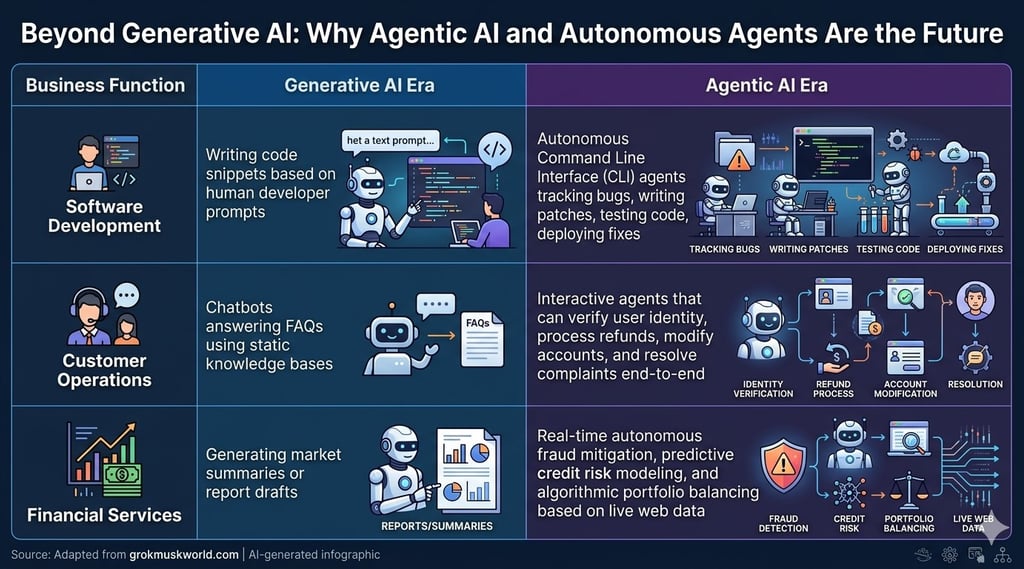
The conversation surrounding artificial intelligence is experiencing a massive paradigm shift. For the past few years, the digital landscape has been dominated by Generative AI—systems designed to create text, generate images, or write code based on direct human prompts.
But as we navigate the technology landscape, the limits of pure generation have become clear. Businesses no longer just want tools that suggest or draft; they want tools that do.
We are officially transitioning into the era of Agentic AI and Autonomous Agents. This article explores why this shift is the definitive future of technology, how it alters business workflows, and what it means for the future of search visibility.
1. What is Agentic AI? The Shift from Task to Goal
To understand why autonomous agents are the future, it helps to look at how they differ from the generative tools we use every day.
Generative AI (Reactive): Operates on an input-output model. You provide a specific prompt, and the AI produces a response. It has no independent agency; it waits for your next command.
Agentic AI (Proactive): Operates on an objective-driven model. You provide a high-level goal, and the AI system autonomously determines the steps required to achieve it, using reasoning, planning, and external tools.
Instead of requiring constant human prompting, an Agentic AI system acts as an independent executor. It can perceive data, reason through roadblocks, split complex objectives into sub-tasks, use APIs to interact with software, and reflect on its results to optimize its next move.
2. The Core Pillars of Autonomous Agent
What makes these modern systems truly autonomous? Enterprise implementations lean on a framework that goes far beyond a standard large language model (LLM).
Advanced Reasoning and Planning: Agents break macro-tasks into micro-steps. If a step fails, the agent self-corrects and tries a different route rather than throwing an error.
Tool Integration and Interoperability: Thanks to standard communication protocols like the Model Context Protocol (MCP), agents aren't locked inside a chat box. They can securely read and write data across your tech stack, from CRMs and databases to secure payment platforms.
Dynamic Context Curation: Early AI struggled with "context rot" or losing track of instructions in long conversations. Modern agentic architectures use targeted, just-in-time data retrieval to keep the agent fast, accurate, and completely aligned with the goal.
3. How Agentic AI Reshapes Business Operations
The commercial drive behind Agentic AI is a demand for true return on investment (ROI) and operational efficiency. Organizations are moving past fragmented chatbots and building "digital assembly lines" using Agent-to-Agent (A2A) networks.
4. The Rise of GEO: Optimizing for AI Agents
For digital marketers and creators, the agentic shift completely changes how content is discovered online. We are moving rapidly from traditional SEO (Search Engine Optimization) to GEO (Generative Engine Optimization)
As consumers increasingly rely on search engines with integrated AI Overviews, or deploy their own personal browser agents to research products, your content's primary reader might no longer be a human—it might be an AI agent
The Inverted Pyramid of GEO: To ensure your brand is cited by autonomous agents, structure your content with direct answers first, backed by explicit data and structured schema markup.
Core Strategies for High AI Visibility
Prioritize Scannability and Structure: Use logical header hierarchies (H1 -> H2 -> H3) and clear tables. Industry data shows that well-structured data tables and lists see a 30% to 40% higher visibility rate in AI-generated answers.
Clear the Crawl Path: Ensure your site's robots.txt configuration explicitly allows access to AI-crawling bots. Avoid heavy, client-side JavaScript rendering for critical content, as many AI crawlers parse only raw HTML.
Establish Clear Authority (E-E-A-T): Agents prioritize verified facts. Cite authoritative data sources, maintain transparent author bios, and frequently update time-sensitive content to keep your site contextually relevant.
5. Human-in-the-Loop: The Future of Work
The rise of autonomous agents does not mean the elimination of human workers. Instead, it elevates our role.
When agents handle data ingestion, continuous monitoring, and repetitive execution, human teams shift from being tactical builders to strategic orchestrators. Humans set the high-level intent, define the ethical guardrails, manage the budgets, and provide final validation.
The future belongs to those who stop spending their days prompting AI, and start building the autonomous workflows that let AI work for them.
Copyright © 2025 Grok Musk World
Connect with us
Prefer privacy-first search? Find us on DuckDuckGo.com, Brave.com Search & Kagi.com : grokmuskworld.com